Timeless Legends: Walking Down Memory Lane — Lest We Forget
OK Success Band
"OK Success Band — Pioneering Congolese-Zimbabwean Rhumba Powerhouse, Resident Giants of Simba Club & Mushandirapamwe, and Legendary Cradle That Nurtured James Chimombe, Susan Mapfumo, the Marxist Brothers, and Fanyana Dube"
The OK Success Band stands as one of the most culturally transformative, enduring, and historically indispensable musical institutions in the annals of Zimbabwean popular music. A pioneering Congolese rhumba ensemble that migrated south from Central Africa in the late 1960s and permanently made Rhodesia (now Zimbabwe) their home, OK Success became far more than just a touring dance band: they evolved into the premier training ground, creative crucible, and springboard that nurtured and launched the careers of many of Zimbabwe's greatest legends — including James Chimombe, Susan Mapfumo, the Chimbetu brothers (Simon and Naison), blind virtuoso Fanyana Dube, comedian Simon Shumba (Mutirowafanza), legendary dancer Virginia Sillah, and Lovemore Majaivana.
The seeds of OK Success were planted in Lubumbashi (in the Katanga region of the Democratic Republic of Congo / Zaire, formerly Elizabethville) by visionary bandleader and guitarist Andrew Ngoyi, bassist and vocalist Joseph Kishala, and singer John Mwale. Joseph Kishala possessed a unique regional pedigree, having been born in Rhodesia to Zambian parents who later returned to Zambia following its 1964 independence; he subsequently ventured into Zaire where he joined forces with Ngoyi. In the late 1960s, captivated by tales of vibrant urban township dance halls across the Zambezi, the group embarked on a transformative journey south through Zambia, arriving in Salisbury (Harare) around 1970.
Upon settling in Salisbury, OK Success quickly established themselves at the center of the thriving black township entertainment circuit. In the late 1960s and 1970s, as black Rhodesians navigated racial segregation and sought an authentic cultural beat, Congolese rhumba — with its buoyant sebene climaxes, chiming guitars, and smooth vocal polyphony — became the default sound of urban nightlife. OK Success secured prestigious residencies at the iconic Simba Club (which later transitioned into the legendary Livewire, then El Morocco, and eventually Jobs Club on Julius Nyerere Way), followed by a landmark multi-year residency at the historic Mushandirapamwe Hotel in Highfield — the cultural Mecca of black Harare during the liberation struggle.
Within months of arriving in Rhodesia, economic realities and touring pressures saw several original Congolese musicians depart or return northward. Refusing to let the band dissolve, Andrew Ngoyi and Joseph Kishala made the historic and visionary decision to recruit talented local Zimbabwean instrumentalists and vocalists. What began as a survival strategy transformed OK Success into a revolutionary cultural hybrid: a master Congolese rhythm section seamlessly integrating the soulful lyrical sensibilities, Shona and Ndebele vernacular idioms, and indigenous melodic cadences of Zimbabwean township youth.
Among the earliest and most monumental local talents recruited into the OK Success ranks was a gifted young guitarist and vocalist named James Chimombe. Performing with OK Success during the mid-1970s, Chimombe honed his immaculate rhythm guitar strumming, stage charisma, and crystalline vocal phrasing under the exacting discipline of Andrew Ngoyi. With Chimombe at the microphone, OK Success recorded some of their most celebrated early classics, most notably the immortal two-part single 'Karigaduri' (Parts 1 & 2) released on Beat City Records, as well as 'Sweet Caroline'. The lessons in arrangements and horn-guitar counterpoint Chimombe absorbed in OK Success laid the direct foundation for his subsequent legendary stints with the Acid Band and Ocean City Band, and his eventual ascension to national superstardom.
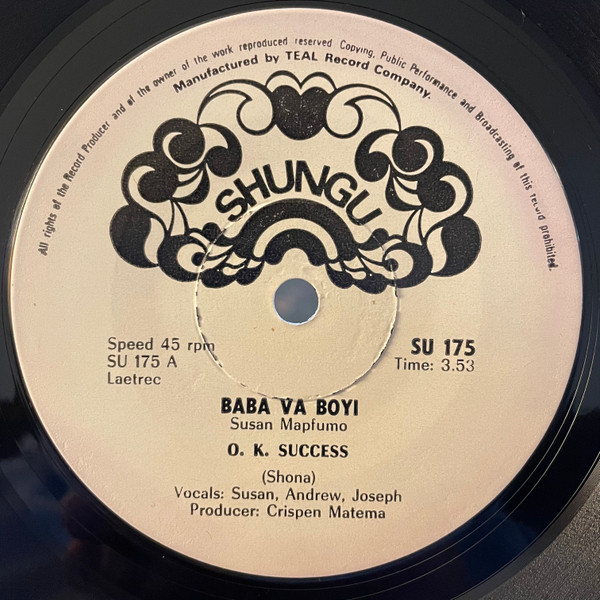
OK Success also provided the launchpad for Susan Mapfumo, widely recognized as one of the most powerful and groundbreaking female voices in Zimbabwean music history. Having previously sung backing vocals for Thomas Mapfumo, it was with OK Success that Susan emerged as a formidable songwriter and lead frontwoman in her own right. She composed and delivered the electrifying hit 'Baba VaBoyi' and the poignant 1976 social masterpiece 'Amai' (Mother), recorded on the Shungu label. In 'Amai', Mapfumo broke ground by singing openly about the pain of being forced into a disastrous, crumbling marriage — offering a rare, courageous female perspective in a male-dominated industry and giving voice to the silent struggles of thousands of African women.
Perhaps the most consequential chapter in the OK Success saga occurred in the early 1980s at the Mushandirapamwe Hotel in Highfield. Two young, aspiring singer-songwriters who had recently moved to Harare from Mashonaland West — Simon and Naison Chimbetu — were discovered harmonizing in a Dzivaresekwa tavern by an astute record producer, who sent them directly to Andrew Ngoyi for professional guidance. Neither of the brothers could play instruments at the time, but Ngoyi recognized their raw vocal genius. OK Success took the young brothers under their wing, rehearsing them extensively and providing the complete instrumental backing for their historic debut 1981 single, 'Nherera' (The Orphan), recorded under the Marxist Brothers moniker. The syncopated, horn-like guitar ostinatos that OK Success played on 'Nherera' formed the very DNA of what would evolve into Zimbabwe's beloved Dendera music genre.
The roll-call of legends who passed through OK Success reflects its status as a veritable national conservatory. Blind multi-instrumentalist virtuoso Fanyana Dube spent a formative stint playing saxophone and guitar with the outfit, sharpening the horn-driven Afro-jazz style he would later showcase in 'Imali'. Celebrated stage comedian and singer Simon Shumba (popularly known as Mutirowafanza) added theatrical flair and humorous vocal interludes to their live repertoire. To hold their own against fierce township rivals such as The Great Sounds and Harare Mambos, OK Success also engaged top-tier stage dancers, including the radiant Virginia Sillah, who became a celebrated recording artist in her own right before marrying Greenford Jangano of the Harare Mambos. Even Bulawayo's legendary 'King of Marabi', Lovemore Majaivana, shared creative moments within their orbit.
By embracing Shona-language songwriting alongside Lingala and French rhumba cadences, OK Success achieved unprecedented grassroots popularity across Rhodesia. Hits such as 'Sekuru', 'Gore Rakapera', 'Mudiwa Mary', 'Chizondo', 'Lupwai Abwela', and 'Amai Ndachema' filled the airwaves of the RBC African Service (later ZBC Radio 2 / Radio Zimbabwe) and packed township community halls from Harare to Bulawayo. When Zimbabwe finally achieved independence in April 1980, OK Success captured the euphoric national mood by releasing the celebratory anthem 'Comrade Mahwina (Tafara)', rejoicing in the birth of the free nation that had adopted them as its own sons.
Beyond the recording studio, Andrew Ngoyi and the members of OK Success were revered for their deep community generosity in the high-density suburbs of Harare and Bulawayo. Living in Mbare, Ngoyi was known to open his home and rehearsals to aspiring youths who had passion but no instruments. At a time when musical equipment was prohibitively expensive and tightly controlled, Ngoyi generously loaned out guitars, amplifiers, and drum kits to nascent township bands, fostering a culture of mutual support that sustained grassroots musicianship across the city.
While changing musical tastes and the rise of fast-paced sungura in the mid-1980s eventually saw the band's commercial dominance wane, OK Success's influence remained indelibly woven into the fabric of Zimbabwean music. The intricate guitar conversations they perfected — the rhythm guitar chugging steadily while the lead guitar soared into rapid-fire arpeggios — became standard vocabulary across sungura, dendera, and Afro-jazz. Without OK Success, the trajectories of James Chimombe, the Chimbetu brothers, Susan Mapfumo, and Zimbabwean rhumba would have looked profoundly different.
Today, the OK Success Band stands proudly and permanently enshrined on the Zimbabwe Digital Wall of Fame as a true ZimLegend. As courageous cultural ambassadors who crossed borders, defied colonial segregation, and generously invested their artistry into the soil of their adopted home, Andrew Ngoyi, Joseph Kishala, and their remarkable Zimbabwean bandmates left a heritage of musical excellence, mentorship, and timeless hits that will forever resonate down memory lane — lest we forget.
Featured Music Videos
OK Success Band — OK SUCCESS — Baba Va Boyi / Sekuru (Historic 1970s Single)
OK Success Band — James Chimombe & OK Success — Karigaduri Pts 1 & 2
OK Success Band — Baba vaBoyi — Susan Mapfumo & OK Success Band
Related Searches
ZimLegends
Top Zimbabwean Talent
Featured
Timeless LegendsTimeless Legends: Walking Down Memory Lane — Lest We Forget