Timeless Legends: Walking Down Memory Lane — Lest We Forget
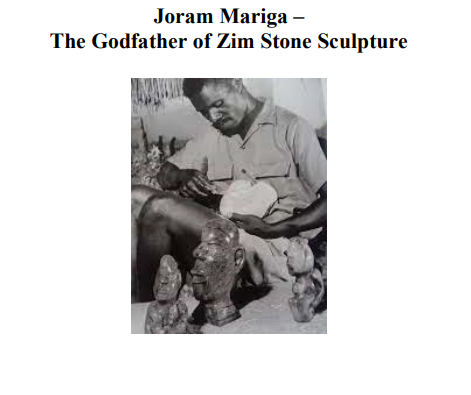
Joram Mariga
"The Godfather of Zimbabwe Stone Sculpture"
One can easily mistake them to be originals of the live versions they represent, but the late Joram Mariga's baboon, milk jug and protective spirit pieces are just products of art. To Mariga, these were family or friends with a story to tell. "One should avoid realism, create a large place for the brain and large eyes, because sculptures are beings who must be able to think and see for themselves for eternity," remarked the man widely regarded as the doyen of stone sculpturing in Zimbabwe in one of his yesteryear interviews.
A deeper look at more of his pieces tends to confirm this view. One can feel the emotions that the sculptures display and the stories they tell. The late Joram Mariga was a first generation genius whose skill of breathing life into wood and stones was legendary. He is the pioneer of stone sculpturing in Zimbabwe, an art he adopted in 1957. Mariga's work would often start by going on the hunt for stones in quarries all over Zimbabwe. Once identified, the sculptor would talk to the stone as a way of "bringing out its spirit".
Talking to stones was a habit that Joram Mariga lived with until he died. It marked the possible beginning for a new sculpture. Some of the stones were selected because of their having a natural face while others required one to be made. Mariga needed to be in a special state of mind for him to be able to talk to the stone and explore its potential. When he was upset with anyone or depressed he could not carve. "If I am happy we talk with each other but when I am sad I cannot talk to the stone," he told Zimbabwe's ZTV in a documentary that the national broadcaster did in his honour way back in 1994.
Mariga anchored most of his works on themes drawn from local culture - particularly the Shona people - and was greatly inspired by nature in his craft. "Some of these rocks are images of animals, some are like human beings and we use those images. Then we have the clouds, particularly in the cold months. Clouds gather and form changing images. We take some of these images and use them for sculpturing," explained Mariga back then. Zimbabwe's stone sculpture promoter, Roy Guthrie of Chapungu Sculpture Park put Mariga's talent into perspective: "He is not inhibited by things which have been taught to him. He works completely naturally. He looks at a stone, sees an image, he has the confidence in his technical skill to pick up his tools and extract that image. And he is not inhibited like so many of us westerners are in expressing himself".
Joram Mariga was a patriotic, self-driven and self-confident sculptor who did not hesitate to take up new challenges. Born near Chinhoyi (formerly Sinoia) to artistic parents in 1927 in what was then Southern Rhodesia, Mariga developed natural interest in sculpturing at an early age. He was already carving wood by the age of eight or nine and joined wood work classes at school. Mariga used to watch his father and two elder brothers, Copper and Douglas, carve wood, while his mother made open-fired ceramics. His father, a sangoma, and elder brothers were all expert woodcarvers. The family did not attach much commercial value to their work. They sold most of their products at give away prices to members of the community.
The late sculptor attended secondary school in Goromonzi and studied at the Waddilove Institute. Mariga qualified as an agriculturist and was employed by Agritex. Soon after his graduation in 1952, Agritex posted Mariga to Inyanga, now Nyanga. The turning point of his stone sculpturing career began in 1957 when he discovered long sought-after caches of green Inyanga (Moon) soapstone while leading a road-constructing team in the Eastern Highlands. Oblivious of the importance of his find, Mariga would use the stone to produce utensils and small figures. He also began teaching members of his road building crew the art of stone carving.
Mariga was a good teacher. He counts among his students renowned sculptors like John and Bernard Takawira, Crispen Chakanyuka, (all his nephews), Bernard Manyadure, Kingsley Sambo, and Moses Masaya who also became legends of the trade. Joram credited his mother for turning out to be the great sculptor that he became. He drew inspiration from her art of making clay pots which he claimed gave him the spiritual support for sculpturing. Mariga belonged to the Shona ethnic group and spoke Zezuru, a local dialect. He grew up awake to the significance of stone in Shona culture and history.
Mariga was part of a sculptural movement usually referred to as "Shona Sculpture", although some of its prominent artists did not belong to the Shona ethnic group. Without outside influence or encouragement, Mariga turned to the rich stratum of Shona beliefs and heritage to inspire his art. His work from the very early times had a strong spiritual dimension. It often portrayed powerful messages and stories accompanied by great depth and innovation. One of his sculptures was depicted on a Rhodesian postage stamp, part of a set issued on 12 July 1967 to commemorate the Tenth Anniversary of the opening of the Rhodes National Gallery.
Pat Pearce, an elderly lady sculptor who lived in Nyanga introduced Mariga to the Englishman, Frank McEwen (late), the first Director of the National Gallery in Rhodesia opened in 1957. McEwen, who was an artist himself and seasoned museum administrator, was instantly enthralled by his work. The art gallery director promoted Zimbabwean art to the outside world through facilitating exhibitions and overseas trips for artists. With the first exhibition in England in the 1960s the world began to know what exceptional sculptors were living in Zimbabwe.
Mariga's maiden exhibition was at the National Gallery of Zimbabwe where he exhibited extensively from 1962. He would, however, always work on his own in his spare time and later at his studio in Greendale, Harare. To show his appreciation for the Englishman, Mariga made a little milk jug carved in soft stone for McEwen. The milk jug and two of Joram's early stone sculptures were part of McEwen's bequest to the British Museum. After 1962 Mariga abandoned the use of soft soapstone, opting for the more challenging larger, harder blocks of serpentine. He began working with new tools. As his technique developed, he taught numerous others what he would have discovered. Others like Joseph Ndandarika, were sent to him for training by McEwen.
By 1967, Joram was arguably the leading Zimbabwean sculptor and the lynchpin of other sculptors seeking to work with newer stones such as serpentine and springstone. Around 1969, Mariga was suspected of harboring ZANU insurgents by the colonial regime and was transferred to a remote region where his art suffered. The area did not have many stones to work with and he ended up carving wood pieces again. Mariga only bounced back to his beloved stone sculpturing in the early 1980s when Zimbabwe attained independence.
His outstanding works saw him become a member of the National Gallery of Zimbabwe's Board of Trustees from 1982 till 1993. Mariga participated in the 1989 Pachipamwe II Workshop held at Cyrene Mission outside Bulawayo, Zimbabwe alongside other contemporary prominent sculptors. In his lifetime, the sculptor has won several international awards and participated in group or solo exhibitions in foreign lands that include The Netherlands, New Zealand. Locally, Mariga featured in a high profile solo exhibition titled "Whispering the Gospel of Sculpture", held at the National Gallery of Zimbabwe in 1989.
Joram Mariga is rightly regarded as the father of Zimbabwe's stone sculpture because of his influence on the local artistic community starting in the 1950s until the time of his death. Mariga was married four times. From his first wife, Doreen, he had a daughter, Mary. His second wife, Philipa, was the mother of Owen, Richard and Robin. Anne, the third wife, gave birth to Walter, Daniel, Aaron and Jay. Mariga married his fourth wife, Maud, in 1976 but the two had no children.
The artist died tragically in December, 2000, when he was involved in a car accident near Rusape. He was pronounced dead soon after arrival at Bonda Mission Hospital. He was aged 73 and still practicing as a sculptor. Mariga's son, Walter, is perpetuating his father's stone carving legacy.
Related Searches
ZimLegends
Top Zimbabwean Talent
Featured
Timeless LegendsTimeless Legends: Walking Down Memory Lane — Lest We Forget